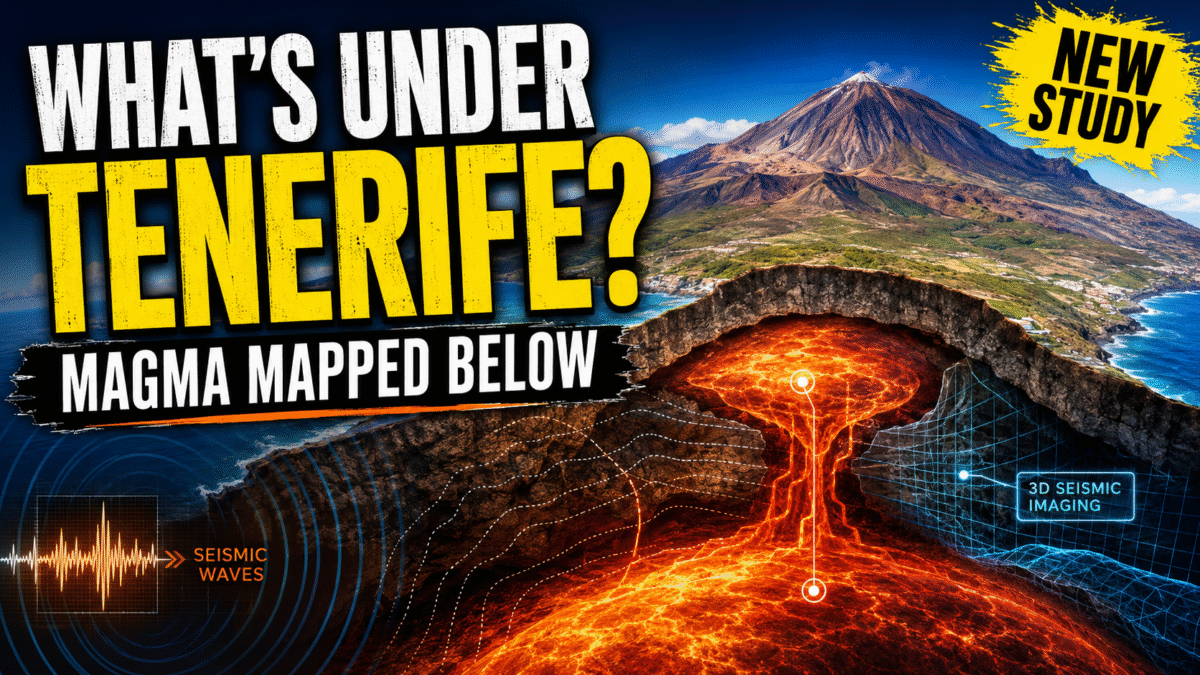
Scientists have created the first detailed 3D image of the volcanic system deep beneath Tenerife — revealing several areas where magma appears to be accumulating beneath the island.
What Has Been Discovered?
A major new scientific study has given researchers their clearest picture yet of what is happening deep beneath Tenerife.
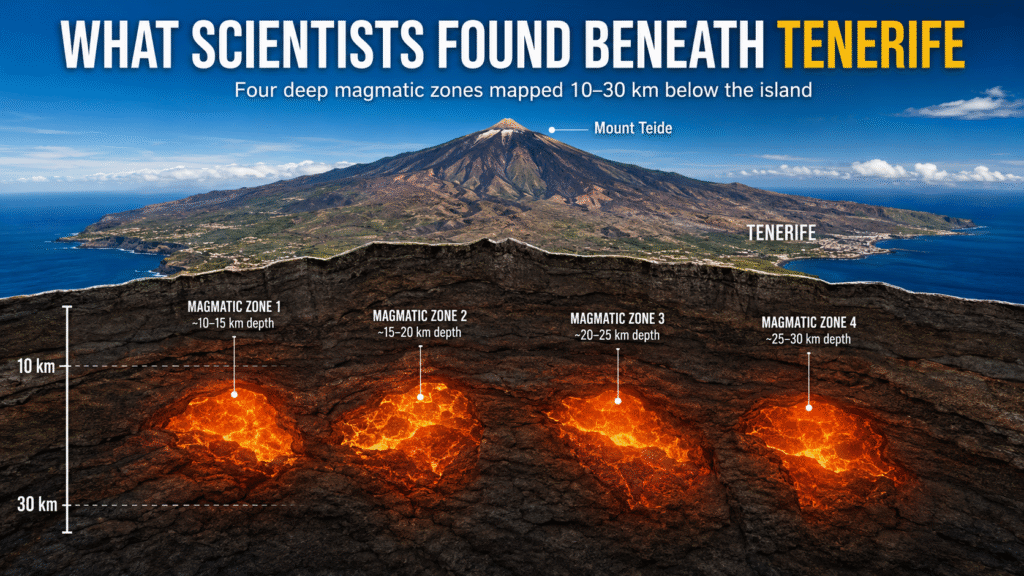
Scientists from the Instituto Volcanológico de Canarias (INVOLCAN), working with researchers from several European institutions, have created the first three-dimensional model of Tenerife’s deep crust and upper mantle.
The findings reveal four large underground areas where seismic waves travel considerably more slowly than in the surrounding rock.
These areas are between approximately 10 and 30 kilometres beneath Tenerife and are believed to contain extremely hot rock and, in some places, significant quantities of partially molten material — magma.
How Did Scientists See Beneath Tenerife?
Clearly, nobody can drill 30 kilometres beneath Mount Teide to take a look.
Instead, researchers used earthquakes occurring thousands of kilometres away.
More than 785 large distant earthquakes, known as teleseisms, were recorded by the Canary Islands seismic network between 2017 and 2024.
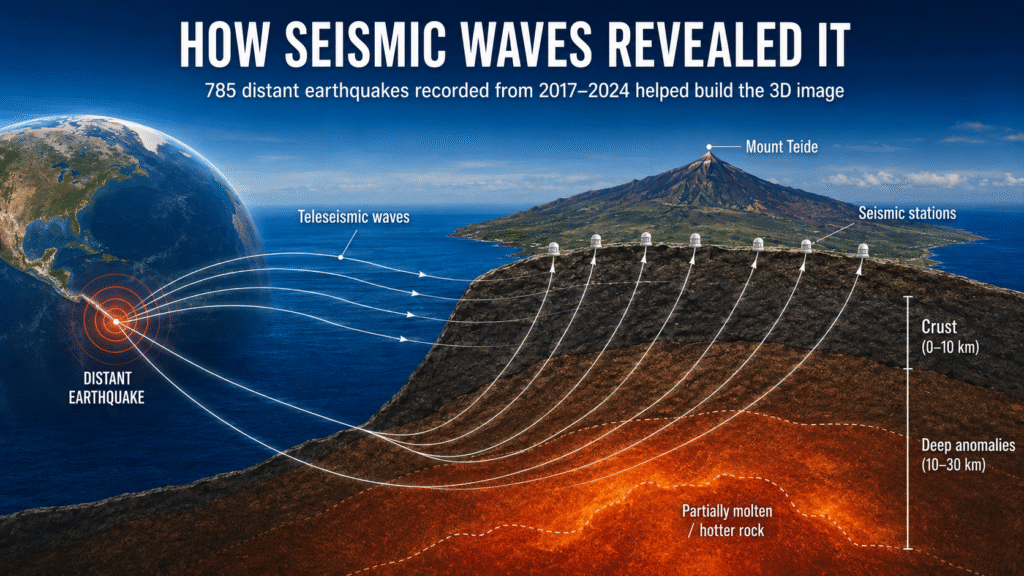
As seismic waves from those earthquakes travelled through Tenerife, scientists were able to examine how their speed and direction changed.
Those changes allowed them to effectively build a three-dimensional picture of the rocks deep beneath the island.
What Is Beneath the Island?
Researchers found that Tenerife sits above an approximately 10-kilometre-thick layer of relatively rigid oceanic crust.
Below this, things become considerably more complicated.
Four major areas were detected where seismic waves move unusually slowly.
Scientists believe these anomalies are associated with very high temperatures and partially molten rock rising from the upper mantle.
The most significant area appears to be beneath western Tenerife, where researchers found exceptionally low seismic-wave speeds.
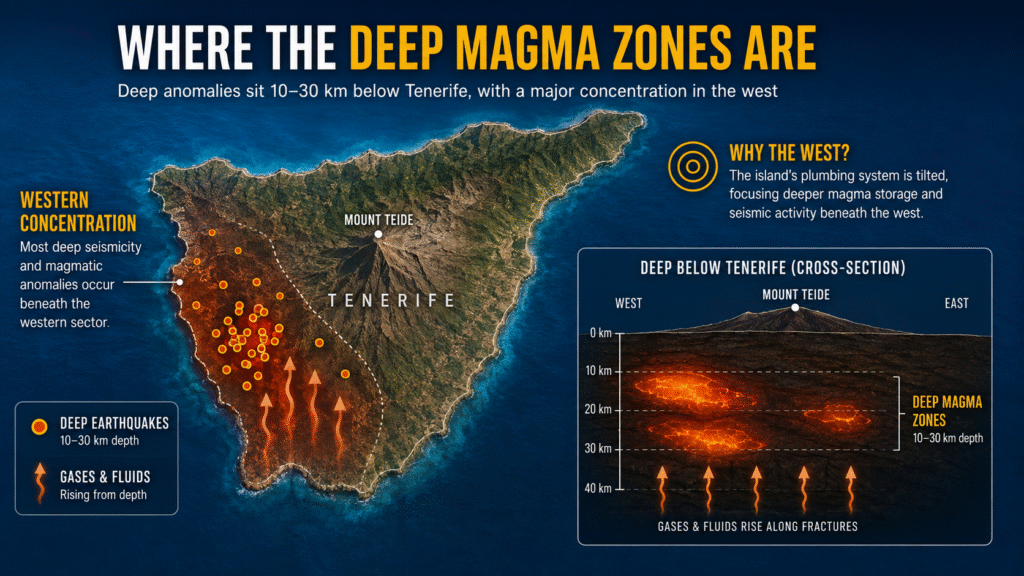
Computer modelling indicates that parts of this region could contain a substantial proportion of molten material.
Scientists believe magma may gradually be collecting underneath Tenerife’s old oceanic crust in a process known as magmatic underplating.
Could This Explain Tenerife’s Recent Earthquakes?
This is perhaps one of the most interesting parts of the research.
Tenerife has experienced periods of unusual seismic activity since around 2016.
Researchers have now discovered that many of those earthquakes are located above, or around the edges of, the newly identified underground anomalies.
That doesn’t necessarily mean magma is moving towards the surface.
Instead, scientists believe movements of magma, heat, gases and fluids at considerable depths could be responsible for at least some of the seismic activity being recorded.
As magma rises, pressure reduces and gases dissolved within it can escape.
One of the most important of these gases is carbon dioxide, or CO₂.
Those gases and other volcanic fluids can then migrate upwards and interact with Tenerife’s hydrothermal system, potentially creating some of the unusual low-frequency and hybrid earthquakes that scientists have recorded.
Does This Mean Tenerife Is Going to Erupt?
No — this research is not an announcement that an eruption is imminent.
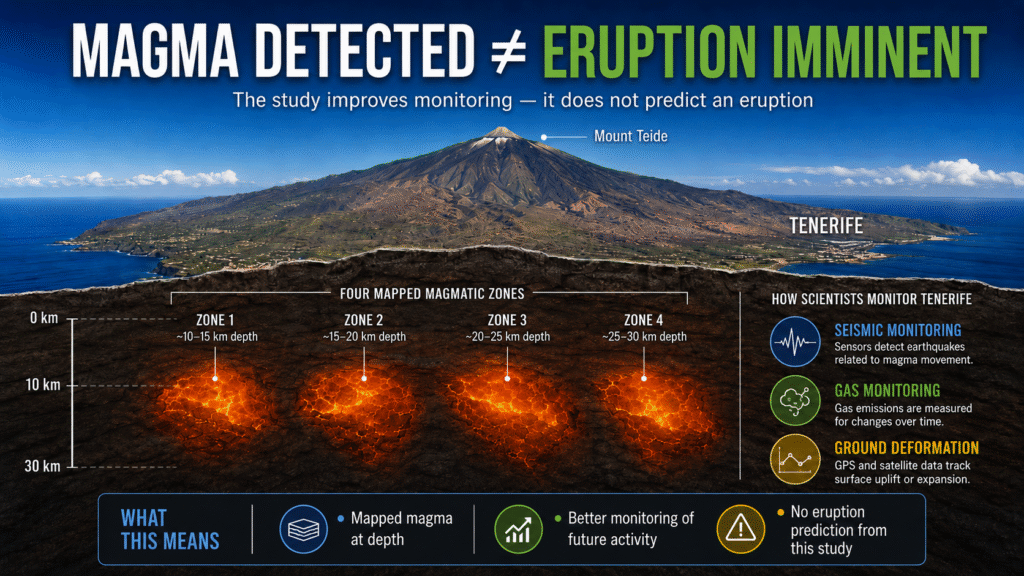
Finding magma beneath an active volcanic island such as Tenerife is not, in itself, unexpected.
What is important about this study is the extraordinary amount of detail scientists can now see.
For the first time, researchers have effectively produced a three-dimensional map showing where some of Tenerife’s deeper magma storage areas appear to be located.
That gives volcanologists another extremely useful tool for comparing future earthquakes, ground deformation and gas emissions with what they now know about the deeper structure beneath the island.
Why This Research Matters
Tenerife is home to one of the most complicated volcanic systems in the Canary Islands.
The Teide–Pico Viejo complex sits where Tenerife’s three major volcanic rift zones meet, and previous research had already suggested magma could be stored at several different depths beneath the island.
This latest study provides considerably more detail.
Rather than being a reason for alarm, it should ultimately help scientists better understand and monitor Tenerife’s volcanic system.
And for those of us living on the island, better monitoring and better information can only be a good thing.
Disclaimer
This article is a summary of publicly available scientific research and news reporting and is intended for general information only. It should not be interpreted as an official volcanic warning, prediction or emergency notice.
The research described here does not state that an eruption of Tenerife is imminent.
For official information concerning volcanic or seismic activity in the Canary Islands, residents and visitors should follow information issued by the appropriate scientific and emergency authorities, including INVOLCAN, Spain’s Instituto Geográfico Nacional and the Canary Islands emergency services.
References
Ground News — 29 August 2026:
Tenerife Unveils for the First Time What It Hides Under Its Volcanoes.
Scientific Reports — 23 August 2026:
Ortega-Ramos, V. et al., Revealing magma storage and underplating beneath Tenerife island from receiver function analysis.
DOI: 10.1038/s41598-026-68243-w
Agencia EFE — 28 August 2026:
Localizan una zona de gran acumulación de magma bajo Tenerife: coincide con la sismicidad anómala.