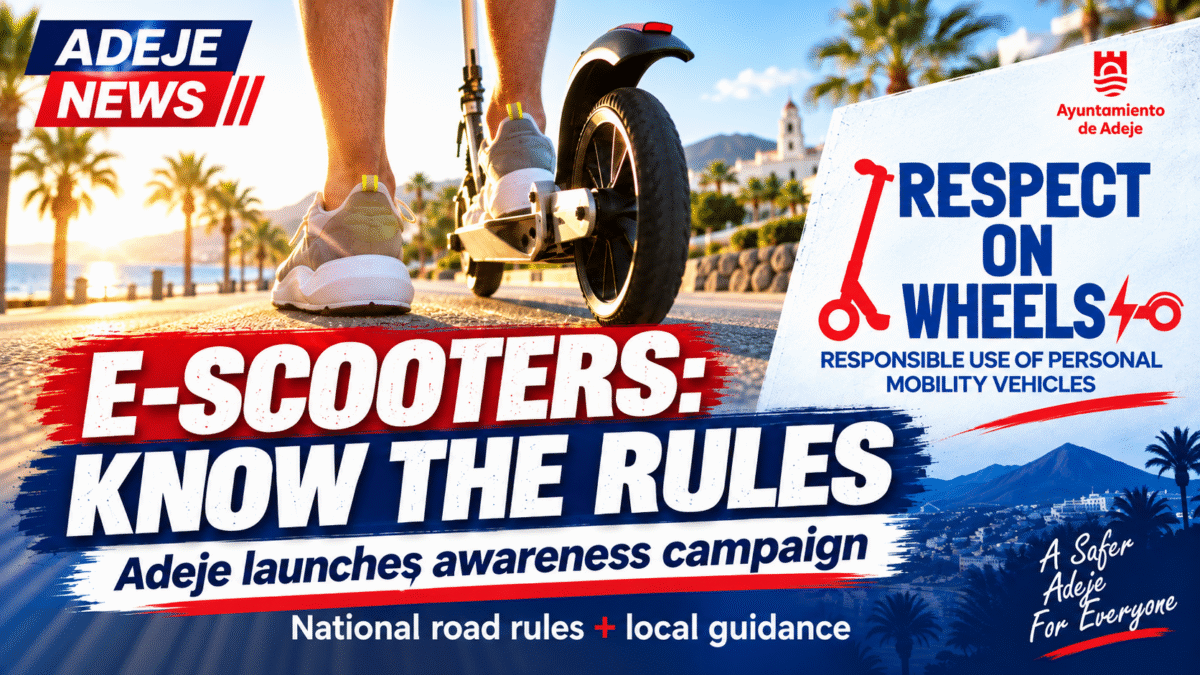
Adeje Town Hall has launched a new public awareness campaign called #RespectOnWheels, aimed at helping residents and visitors better understand how electric scooters and other personal mobility vehicles should be used safely and responsibly.
The important point here is that this is not a separate set of “Adeje rules” for the whole Canary Islands. Rather, Adeje is running an information and awareness campaign to explain the rules that apply to e-scooter users. In practice, that means a mixture of Spain-wide road traffic rules and local municipal guidance about where these vehicles can circulate and how they should be used in shared public spaces.
The Town Hall says the campaign is designed to improve coexistence on the streets, protect pedestrians and promote safer urban mobility. It is aimed particularly at users of Personal Mobility Vehicles (PMVs), especially electric scooters, and is being promoted through social media, videos, infographics, radio adverts and practical examples of good practice.
National rules and local guidance
The simplest way to think about it is this:
- National rules provide the basic legal framework for e-scooters in Spain.
- Local ordinances can decide some of the details, especially in urban areas.
So while Adeje is helping explain the rules, the campaign is mainly a way of making the law clearer and easier to follow, rather than inventing a whole new rulebook for the municipality.
That is why the messaging matters. A better summary is:
National road rules + local guidance
The key safety messages
The campaign focuses on a number of simple, easy-to-understand safety points:
- Keep off pavements and pedestrian areas
E-scooters should not be ridden on pavements or in spaces meant primarily for pedestrians. - Ride only where allowed
Use urban roads and cycle lanes where permitted, and follow local signage and municipal guidance. - Respect the speed limit
The general maximum speed for this type of vehicle is 25 km/h, and riders should always slow down around other people. - One rider only
E-scooters are designed for one person. Carrying passengers is not allowed. - No phones or headphones while riding
Riders need to stay alert and keep their attention fully on the road or route ahead. - No alcohol or drugs
The same road safety rules apply. If you would not drive under the influence, you should not ride an e-scooter either. - Park responsibly
Do not leave scooters blocking pavements, crossings or access points. Pedestrians always come first.
Why this matters
E-scooters have become a common sight across Tenerife and the Canary Islands. They are convenient, modern and environmentally friendly, but they can also create problems if used carelessly — especially in busy tourist areas, on promenades and in places shared with pedestrians.
Adeje’s campaign is really about respect: respect for pedestrians, respect for shared spaces and respect for the rules that help keep everyone safe.
It is also a useful reminder that many people wrongly assume e-scooters can be ridden anywhere. That is not the case. Riders need to know both the general national rules and any local restrictions or guidance that apply in the area where they are using them.
Looking ahead
There are also wider national changes to e-scooter regulation coming into force in Spain, so riders should keep an eye on official updates and not rely only on word of mouth or social media. Campaigns like this are helpful because they make the information easier to understand, but the safest approach is always to check the official source material directly.
Official links
Adeje campaign information (Spanish):
https://www.adeje.es/vmp
Adeje campaign information (English):
https://townhall.adeje.es/?noticia/10581/respect-on-wheels
DGT guidance on e-scooters / VMPs:
https://www.dgt.es/muevete-con-seguridad/viaja-seguro/en-patinete/
Disclaimer
This article is a plain-English summary for information and commentary purposes only. It is not legal advice. Rules can change, and local ordinances may add further conditions or restrictions. Always check the latest official information from the DGT, the BOE and your local council before relying on any specific rule.
Sources
- Adeje Town Hall press release: #RespectOnWheels
- Ayuntamiento de Adeje campaign website
- Dirección General de Tráfico (DGT)
- Spanish traffic regulations / BOE