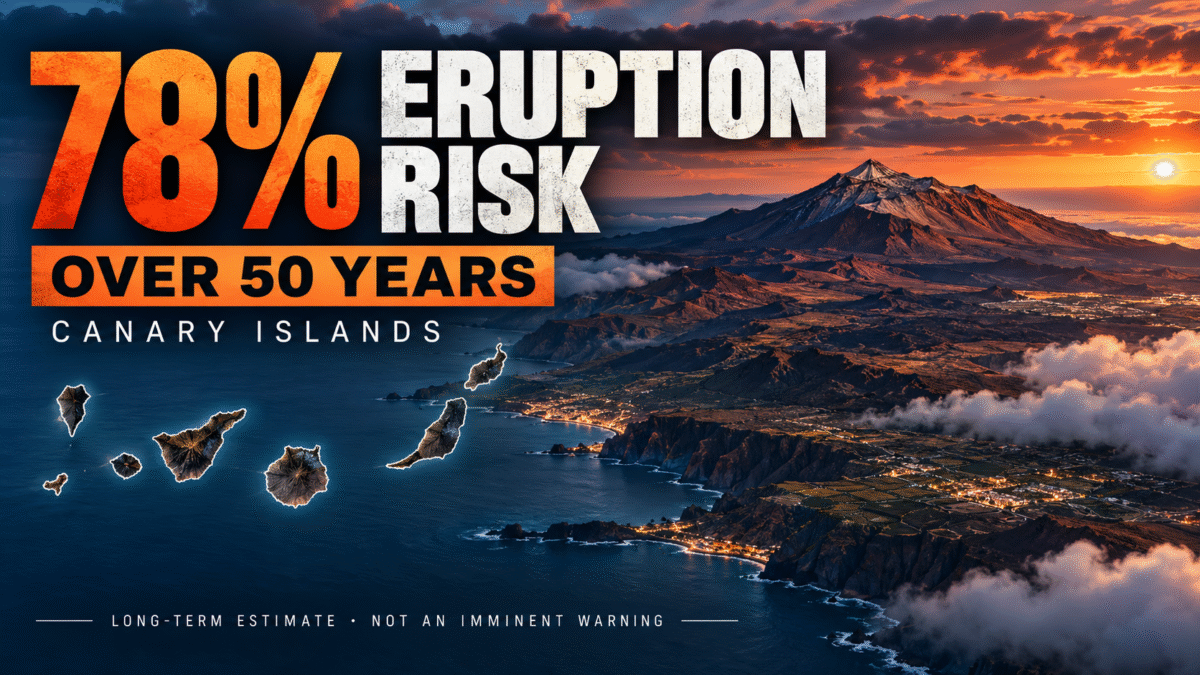
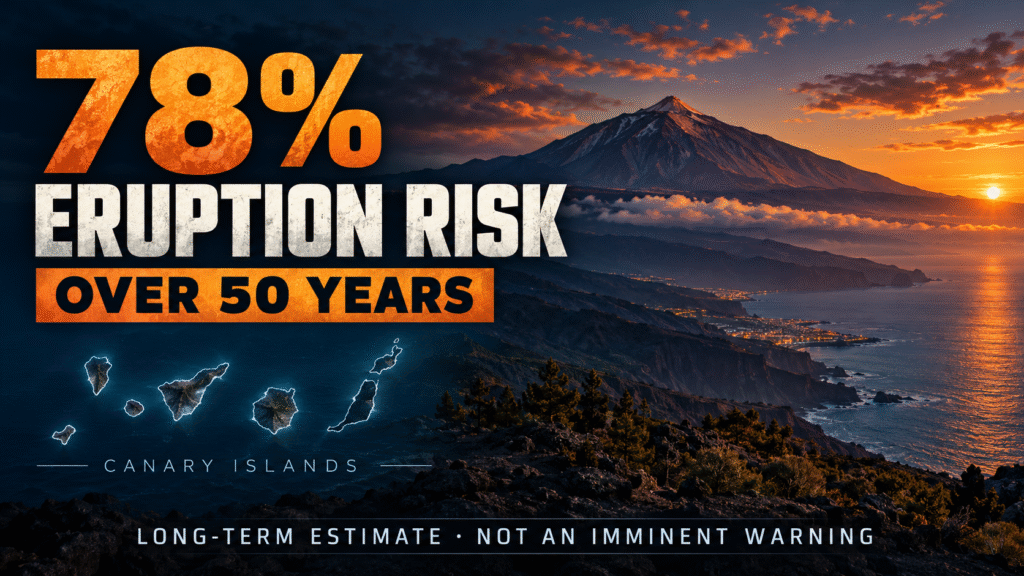
A new volcanic risk directive published by Spain’s Official State Gazette puts the probability of an eruption somewhere in the Canary Islands at 77.69% over a 50-year period. That is the figure behind the rounded 78% headline.
The estimate applies to the archipelago as a whole. It does not say which island might be affected, where an eruption would happen, or when. And it is not a forecast of an eruption in the near future. The directive also gives a 33-year recurrence interval as a statistical equivalent; that should not be read as a countdown or a promise that an eruption will happen every 33 years.
The new rules update Spain’s civil protection planning for volcanic emergencies, replacing the previous national directive from 1996. They set common requirements for emergency plans, including risk maps, monitoring and alert systems, public information, coordination between administrations, and measures to protect people. The framework applies across the Canary Islands, with more detailed local planning intended for islands and municipalities identified as priorities on the risk maps.
The point of the figure is to help authorities prepare for a real, long-term volcanic hazard. It does not mean there is currently a sign of an impending eruption.
Disclaimer: This is a plain-English summary of the reporting and the official document cited below. The probability is a statistical estimate for the Canary Islands over 50 years; it is not an individual island forecast or a short-term eruption warning.
Sources:
● El Día: Canarias has a 78% probability of suffering an eruption