What Has Changed for Drone Flying in Spain?
If you fly a drone in Spain, particularly in towns, resorts and along the coast, two parts of Royal Decree 517/2024 are particularly important: Article 39 and Article 40.
These rules apply regardless of whether you are flying recreationally or creating content for YouTube.
For small drones such as the DJI Neo 2, which is a C0 drone weighing under 250 grams, the European rules are relatively relaxed.
However, Spain adds additional restrictions depending on where you are flying.
Article 39 – Essential Infrastructure
Article 39 protects infrastructure considered essential to the community.
This includes:
- Roads and railways
- Ports and other transport infrastructure
- Power stations and electrical infrastructure
- Fuel installations and refineries
- Water and gas infrastructure
- Telecommunications infrastructure
- Certain hospitals, health facilities and security installations
For linear infrastructure such as roads and railways, the protected zone generally extends 25 metres horizontally beyond the infrastructure.
For non-linear infrastructure, the protection area generally extends 10 metres horizontally.
The protected volume normally extends upwards to 50 metres above the highest point of the infrastructure.
Flying inside these protected areas requires the prior express permission of the owner or operator of the infrastructure.

For drone pilots this means that an apparently harmless flight beside a road, port or other infrastructure may require additional permission.
The fact that a drone weighs less than 250 grams does not automatically exempt it from Article 39.
Article 40 – Urban Areas
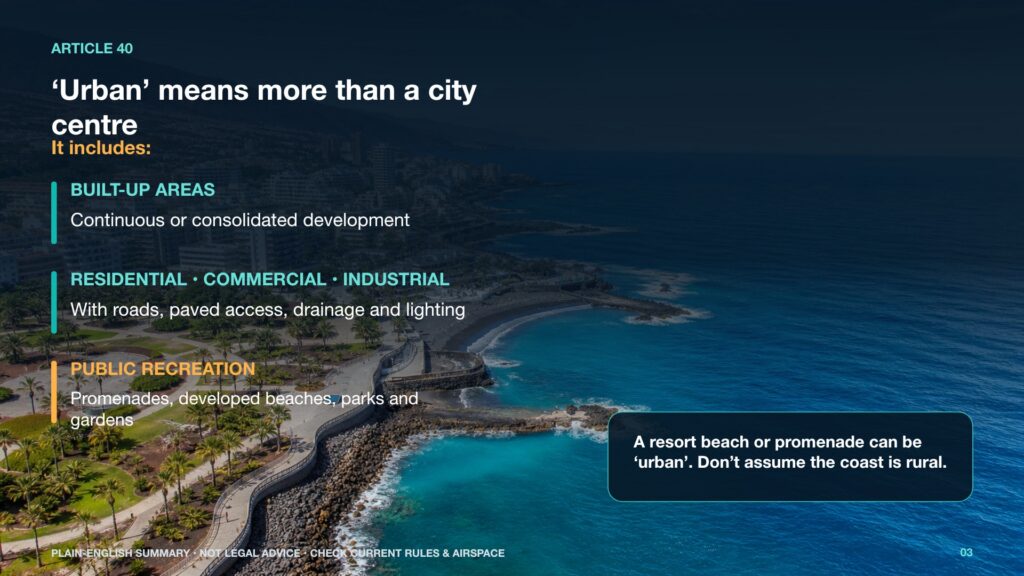
Article 40 is particularly important for people using small drones around Spanish towns and resorts.
The definition of an urban environment is much wider than simply a city or town centre.
It includes:
- Built-up towns and villages
- Residential areas
- Commercial areas
- Industrial areas
- Areas with roads, paved pedestrian access, drainage and street lighting
- Certain public recreational areas
- Developed beaches
- Municipal parks and gardens
This means somewhere that we might normally describe as suburban can still legally be considered an urban environment for drone purposes.
The Five-Day Notification Rule
This is probably the biggest surprise for many owners of small drones.
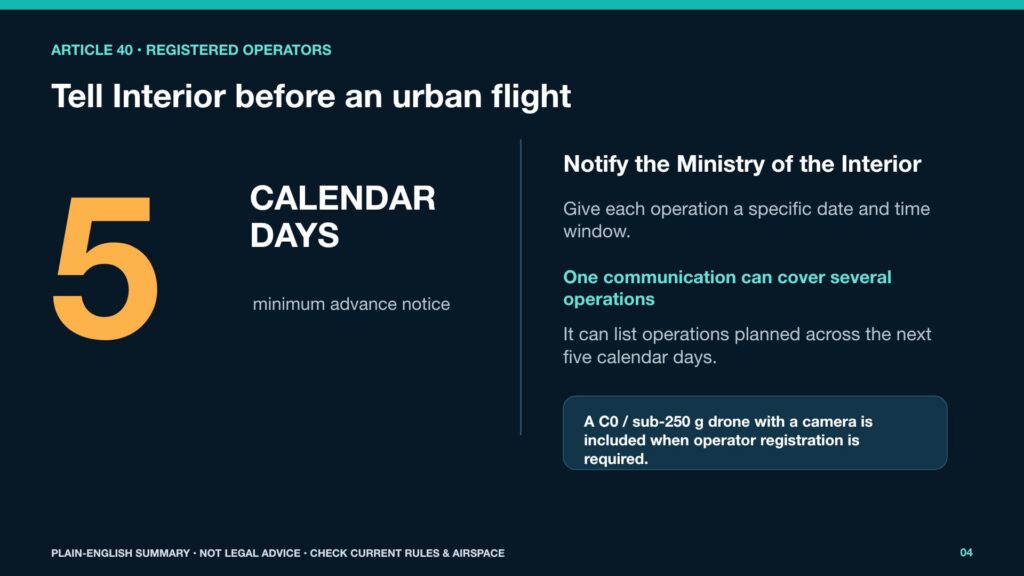
If the drone operator is required to be registered and wants to operate in an Article 40 urban environment, the operation must normally be communicated to the Spanish Ministry of the Interior at least five calendar days beforehand.
This also applies to C0 drones weighing less than 250 grams when the operator is required to register — for example, a normal camera-equipped drone such as the DJI Neo 2.
The notification can contain multiple planned operations within a period of up to five calendar days.
That means a pilot who regularly visits several locations could potentially notify several different possible flights in advance and simply not carry out the flights that are not needed.
This does not mean that the Ministry notification gives blanket permission to fly.
All the other rules still apply.
What About a DJI Neo 2?
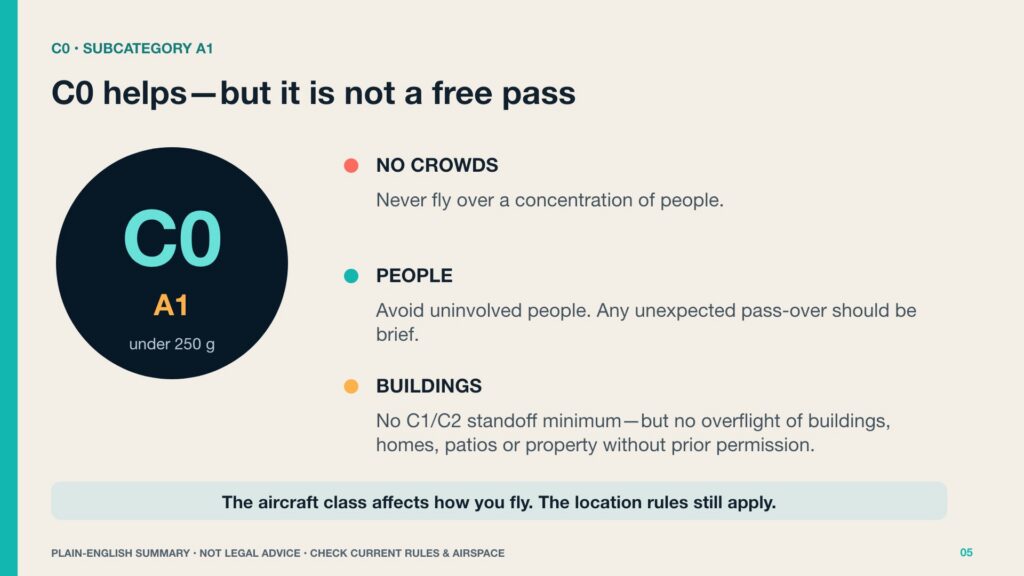
A C0 drone such as the DJI Neo 2 still has some significant advantages.
Under the normal A1 rules:
- No A1/A3 examination is normally required for C0
- There is no Article 40 minimum 5-metre or 30-metre building separation applying specifically to C0
- An occasional uninvolved individual may be overflown where necessary, although it should be avoided
- Flying over a crowd is prohibited
- The drone must remain within the applicable visual-line-of-sight rules
- Other geographical restrictions still apply
However, Article 40 also restricts flying over houses, buildings, patios and similar property in urban environments unless the necessary permission has been obtained.
What About Promenades?
This is where the law becomes frustrating for small “flying camera” drones.
A promenade in a developed resort is very likely to fall within the Article 40 definition of an urban environment.
So taking a small drone out of your pocket and spontaneously using Follow Me while walking along the promenade may still trigger the five-day notification requirement.
The Follow Me function does not create a special exemption from Article 40.
Likewise, hand launching the drone instead of taking off from the ground does not create an exemption.
Can You Still Fly Spontaneously?
Potentially, yes.
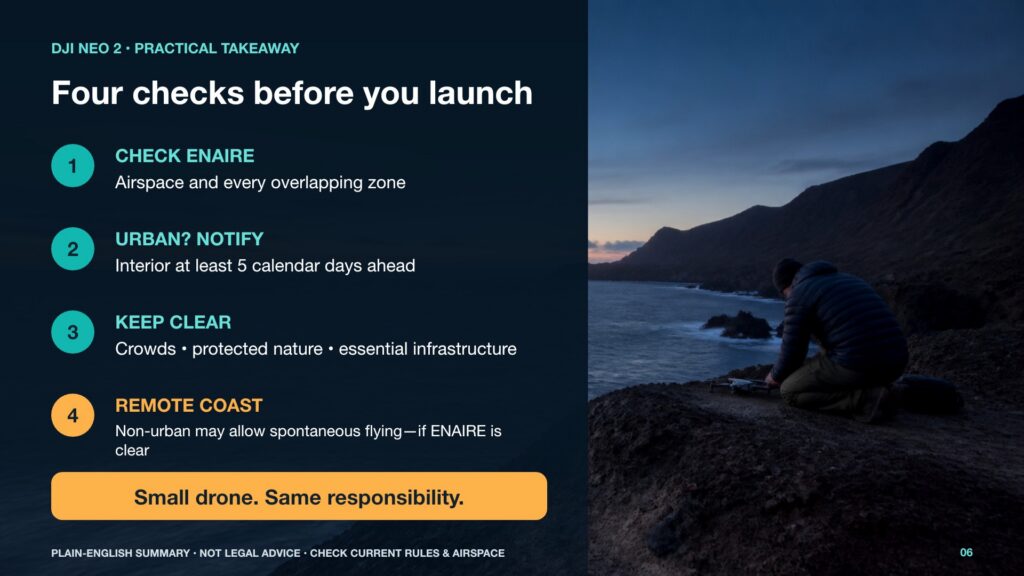
A genuinely undeveloped and non-urban stretch of coastline may fall outside Article 40.
That could allow a spontaneous flight provided:
- ENAIRE shows no conflicting airspace restriction
- It is not within a protected natural area
- It is not within an Article 39 infrastructure zone
- It is not within an airport or heliport restriction
- There is no crowd
- All normal Open Category rules are followed
So a remote coastal path may actually be easier legally than a quiet promenade in a tourist resort.
Check Before Every Flight
Before flying anywhere in Spain, drone pilots should check the official ENAIRE Drones map.
It shows geographical drone zones, airport restrictions, controlled airspace and many other restrictions affecting a proposed flight.
Environmental restrictions may also apply separately, particularly in national parks and protected natural areas.
For example, recreational drone flying in Teide National Park is generally prohibited, regardless of whether the drone weighs under 250 grams.
The Practical Takeaway
For a small C0 drone, the basic European rules are quite accommodating.
The complication in Spain is often the location rather than the weight of the drone.
A simple way to remember it is:
Article 39 = Essential infrastructure
Article 40 = Urban environments
And for registered operators:
Urban flight = normally notify the Ministry of the Interior at least five days beforehand.
Always check the exact location before flying.
Disclaimer
This article is a plain-English summary intended for general information and discussion. It is not legal advice.
Drone regulations, geographical zones, temporary airspace restrictions and environmental rules can change. Pilots remain responsible for checking the current requirements for the exact location and planned operation before flying.
References
- Boletín Oficial del Estado (BOE): Royal Decree 517/2024, particularly Articles 39 and 40
- AESA – Agencia Estatal de Seguridad Aérea: UAS Geographical Zones and guidance on Royal Decree 517/2024
- ENAIRE Drones: Official Spanish drone airspace and geographical-zone mapping service