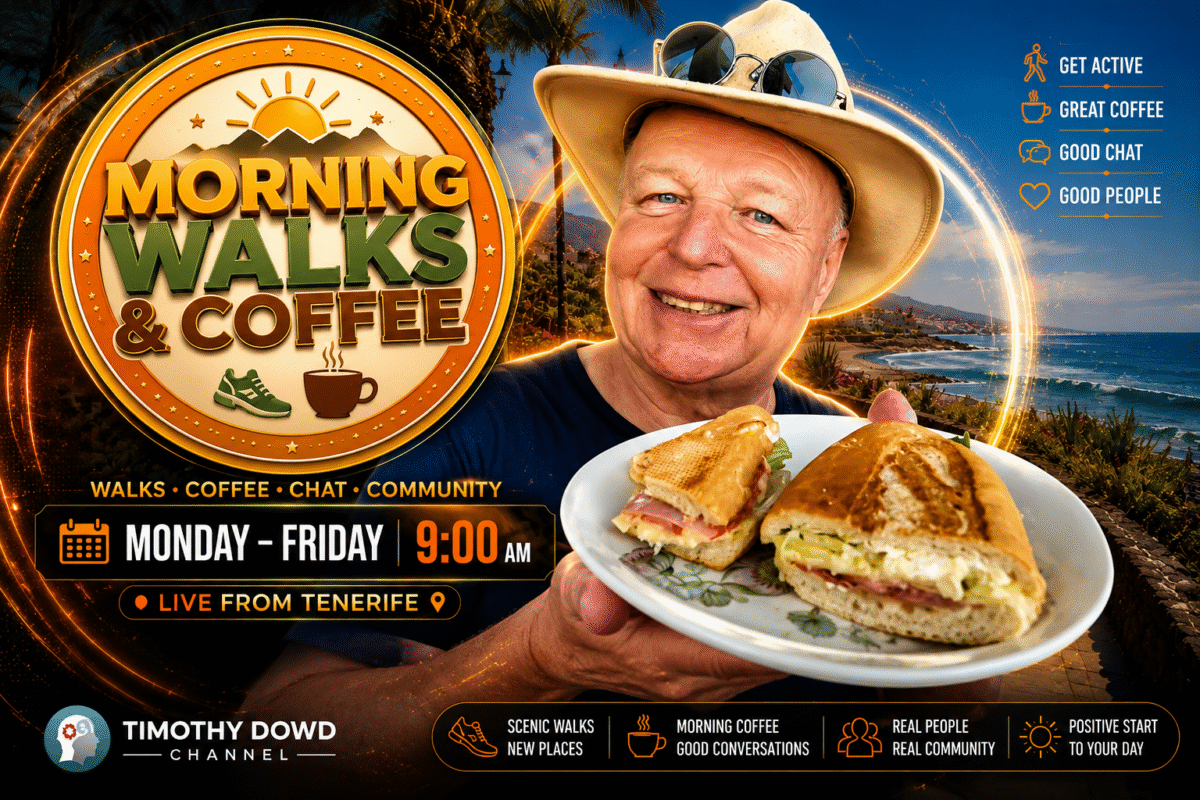
Most people who say they are heading to “Adeje” mean the coast: Costa Adeje, the hotels and the beach promenade. The actual town of Adeje, further inland and up the hill, is a different place entirely.
It is where the municipality has its roots, where the old church of Santa Úrsula stands and where, on a clear morning, you can enjoy one of the best views across the south of Tenerife.
That was where I headed for this Friday morning broadcast.
Finding Your Way Up
There is a multi-storey car park near the top of Adeje town. It is not free, but it is inexpensive and conveniently placed for Casa Fuerte, Plaza de España and the surrounding streets.
Those arriving by bus can get off in Adeje town centre and walk uphill along Calle Grande. It is a pleasant, tree-lined street with restaurants, cafés, bars and a few hotels along the way.
Continue towards Plaza de España and the church of Santa Úrsula. From there, turn left and you are almost at Casa Fuerte.
It is worth making the effort because this part of Adeje feels very different from the coastal resorts below.
Casa Fuerte: The Strong House
Casa Fuerte means “strong house”, and the building certainly has a history to match its name.
The last sugar mill on Tenerife operated in Adeje during the middle of the 16th century, using water from the Barranco del Infierno ravine.
The Ponte family later received permission to construct a fortified residence here to help defend the area against pirate attacks. Casa Fuerte went on to become the political, economic and social centre of Adeje for around three centuries.
The complex sits somewhere between a country estate and a fortress. Its almost square site covers approximately 7,200 square metres.
Inside, there were once storehouses, granaries, stables, a blacksmith’s workshop, a bakery, residential quarters, an oratory, a palace and a defensive tower.
One of its most important features was the archive room. The French naturalist Sabin Berthelot wrote that it contained four large cupboards filled with historical documents. The Canarian historian Viera y Clavijo reportedly described the collection as the treasury of the Canary Islands.
Guided visits are available during the morning, although it is always sensible to check the latest opening arrangements before making a special journey.
Cafetería El Salón
Next to Casa Fuerte is Cafetería El Salón, which is run by Rita and her family.
Rita speaks excellent English, partly because of her family’s connections with London, although the family originally comes from Gran Canaria.
The café is welcoming, relaxed and full of character. It is also the sort of place that makes you wonder why you did not discover it sooner.
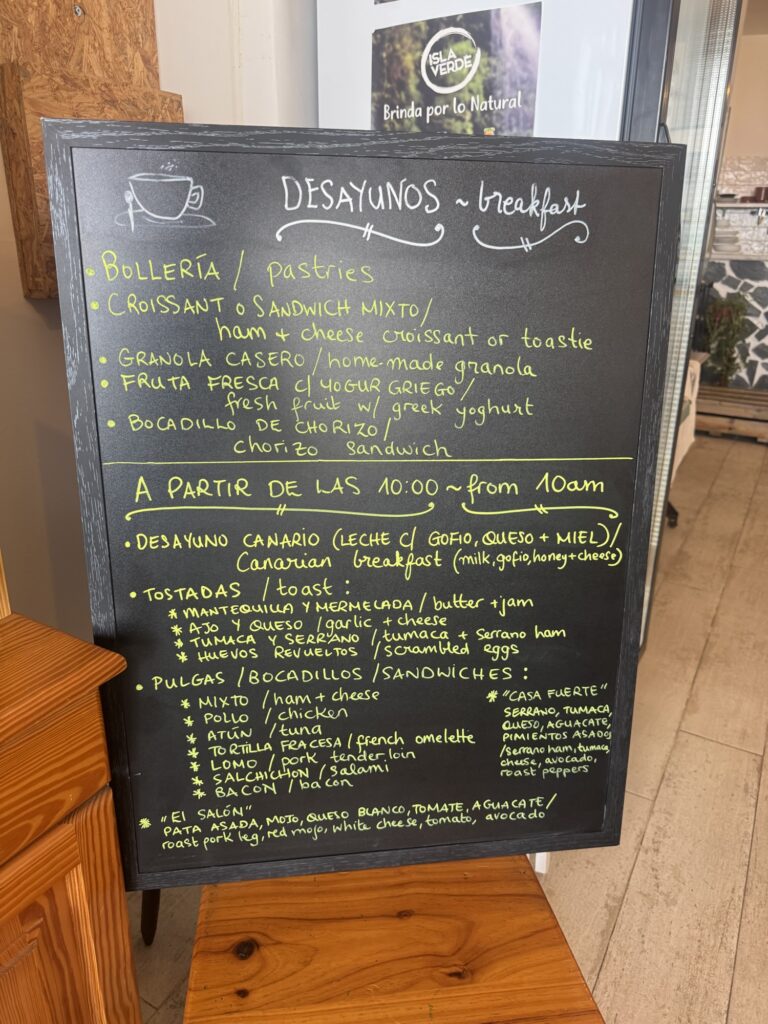
The menu is displayed on large boards, so I photographed them and worked my way through the choices during the broadcast.
Breakfast at El Salón
Breakfast includes familiar options such as croissants, mixed toasted sandwiches, homemade granola with dried fruit and Greek yoghurt, fresh fruit with yoghurt and chorizo bocadillos.
The chorizo is the soft, spreadable variety. It is toasted on the grill until it becomes warm, slightly caramelised and thoroughly tempting.
After 10:00, you can also order a traditional Canarian breakfast made with milk, gofio, honey and cheese.
Gofio is a toasted flour that has been part of the Canarian diet for centuries. Served this way, it has a texture similar to porridge and is probably one of the friendliest introductions for anyone trying it for the first time.
There is also a wide selection of pulgas, bocadillos and sandwiches.
A pulga is essentially a smaller bocadillo, which is useful when you want something more substantial than a snack but do not fancy tackling a full-sized sandwich.
Fillings include chicken, tuna, French omelette, pork tenderloin, salami and bacon.
Two of the sandwiches are named after the café and the historic site.
The El Salón bocadillo contains roast pork, red mojo, white cheese, tomato and avocado. The Casa Fuerte version includes Serrano ham, tomato spread, cheese, avocado and roasted peppers.
Lunch Specials and Desserts
The lunch menu is straightforward, local and very reasonably priced.
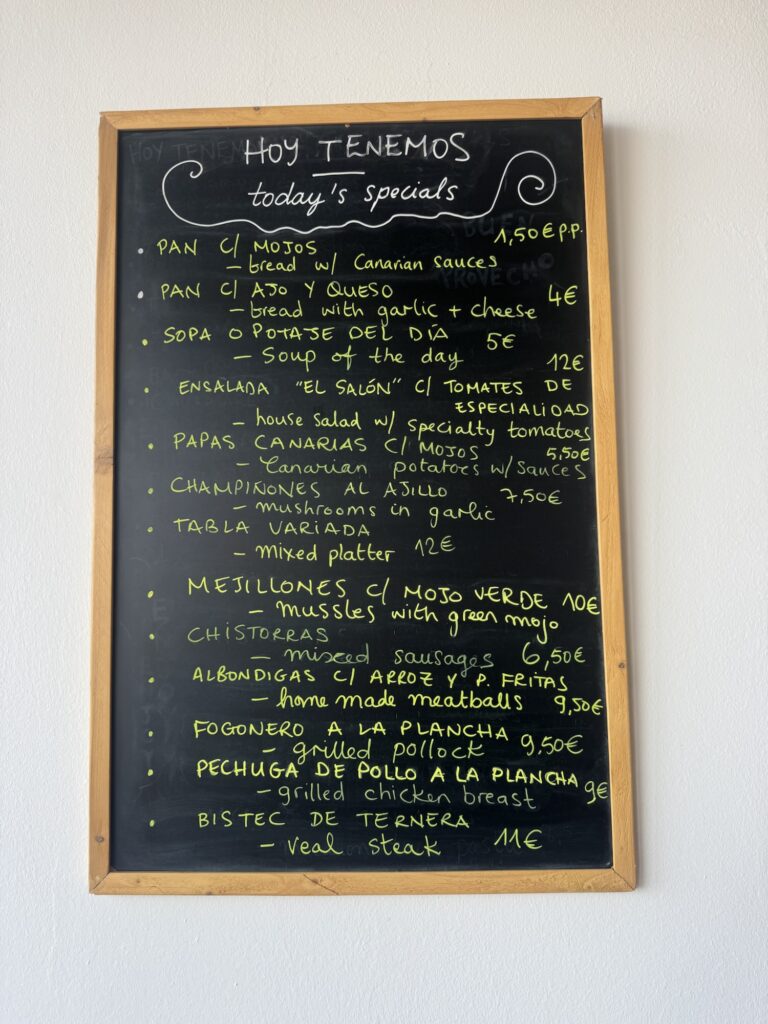
Options include bread with Canarian sauces, garlic bread with cheese, soup of the day, house salad, Canarian potatoes with mojo, garlic mushrooms, mussels with green mojo, sausages, homemade meatballs, grilled fish, chicken and veal steak.
The prices were noticeably lower than those found in many of the busier tourist areas.
Desserts included a café gourmand with several small sweets, homemade ice cream, dulce de leche, almond and honey cake, a cake of the day and a fruit cocktail.
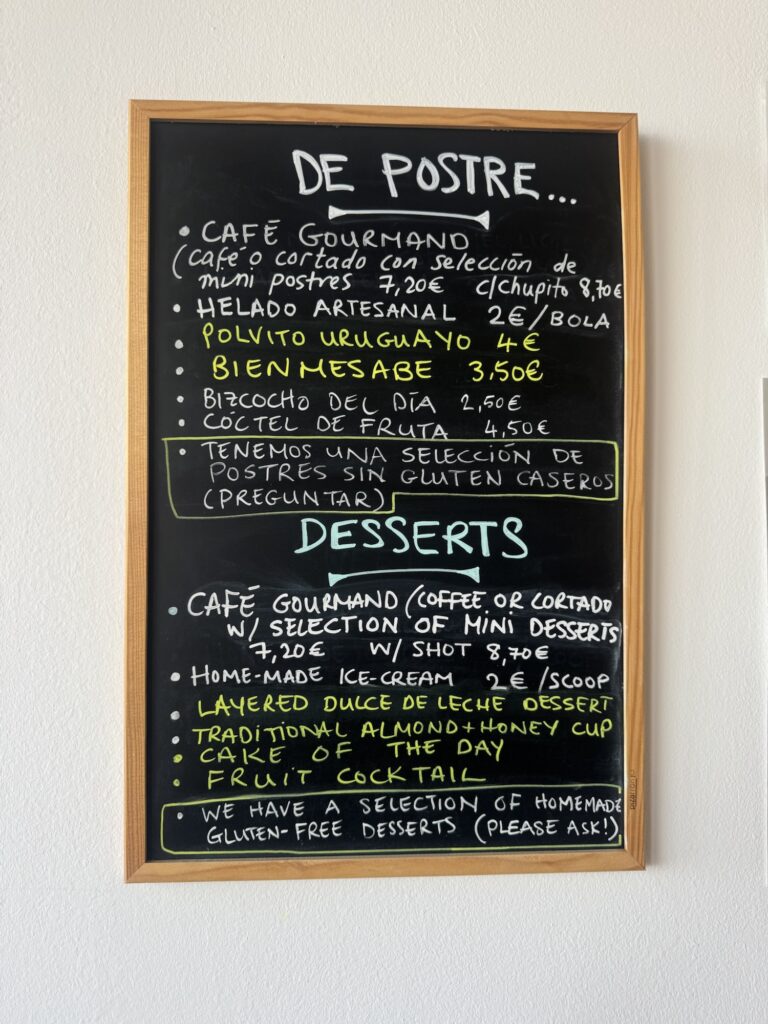
Gluten-free desserts were also available on request.
The Bacon That Wasn’t There
I had been looking forward to one of my usual bacon sandwiches, but Rita had run out of bacon.
This appears to be becoming something of a tradition whenever I visit.
Instead, I ordered a lomo bocadillo. Lomo is pork loin, and Rita described it as the nearest alternative she could offer to back bacon.
She was right.
It arrived in a soft, fresh roll with salad, cheese, onion, mayonnaise, olive oil, salt and pepper. The bread held together properly and was nothing like some of the hard, dry bocadillos I remember struggling with years ago.
It was a very good sandwich and more than made up for the missing bacon.
The coffee was excellent too. The café uses a house blend called Topinambur, although I spent most of the broadcast trying to pronounce it correctly.
The Artisan Shop
At the back of the café is a small shop selling Canarian artisan products.
There were mojos, sauces, local wine, pottery, mugs and decorative pieces, alongside older items such as traditional weighing scales and a treadle sewing machine.
It feels more like a genuine local shop than a tourist souvenir outlet.
The kombucha caught my attention. Several flavours were available, including mango and pineapple, mango and papaya, strawberry and blackcurrant, fig and níspero.
Níspero is the fruit known in English as loquat.
I bought two brioche buns from the counter.
The shop follows the same general philosophy as the café: local products, homemade food and things that have been made with some care.
Affordable Housing in Tenerife
During the broadcast, a viewer asked whether the Tenerife authorities had any plans to address the shortage of affordable housing.
The honest answer is yes and no.
There have been attempts to discourage properties from going directly into short-term holiday rental. Restrictions affecting some new properties are intended to encourage more homes to remain available for residents.
The problem is that many of the newly constructed properties are still too expensive for ordinary local buyers.
Some owners can also afford to leave apartments empty rather than reduce the rent. In our own building, several of the apartments are currently unoccupied.
Dropping the price can create another problem because existing tenants may then question why they are paying more.
That means change tends to happen slowly, even when properties are visibly sitting empty.
There are reports of more affordable rental housing being developed in the area, but the overall shortage will not be solved quickly.
My New Descript and ChatGPT Workflow
I have also been experimenting with a new production workflow, and it has made an enormous difference to the amount of time I spend processing each video.
My old routine involved returning home, removing the memory card, copying the footage to an external drive, importing everything into Final Cut Pro and creating or extracting a transcript.
I would then copy the transcript into ChatGPT to produce a summary, chapter markers, title ideas, a description and material for the blog.
After that, I still had to find suitable clips, format them, add captions, create a thumbnail and upload everything.
The complete process regularly took between three and four hours.
I eventually realised that I could do much of this directly through Descript, a service I had already been paying for but not using to its full potential.
Descript automatically transcribes the recording. With ChatGPT connected to the project, I can then ask it to review the programme, identify the strongest sections and prepare the publication material.
It can produce title suggestions, descriptions, accurate chapters and a blog article. It can also identify suitable short clips and create separate vertical compositions for YouTube Shorts.
For the vertical clips, the original widescreen footage remains centred and unchanged. A synchronized copy fills the portrait frame behind it and is heavily blurred, while captions are placed above the main picture.
For sections where I am talking about a photograph or menu, the image can be shown as a full-screen cutaway while the original audio continues.
The raw recording is usually several gigabytes, so uploading it still takes a few minutes. Once it is in Descript, however, most of the processing can now be completed in around twenty to thirty minutes rather than several hours.
It genuinely feels like having a production assistant.
I have experimented with fully AI-generated pieces as well, including scripts, artificial voices and automatically selected footage. Technically, the results can be impressive.
However, that is not the direction I want for the main channel.
The technology should handle the repetitive mechanics, but the voice, opinions and personality still need to be mine.