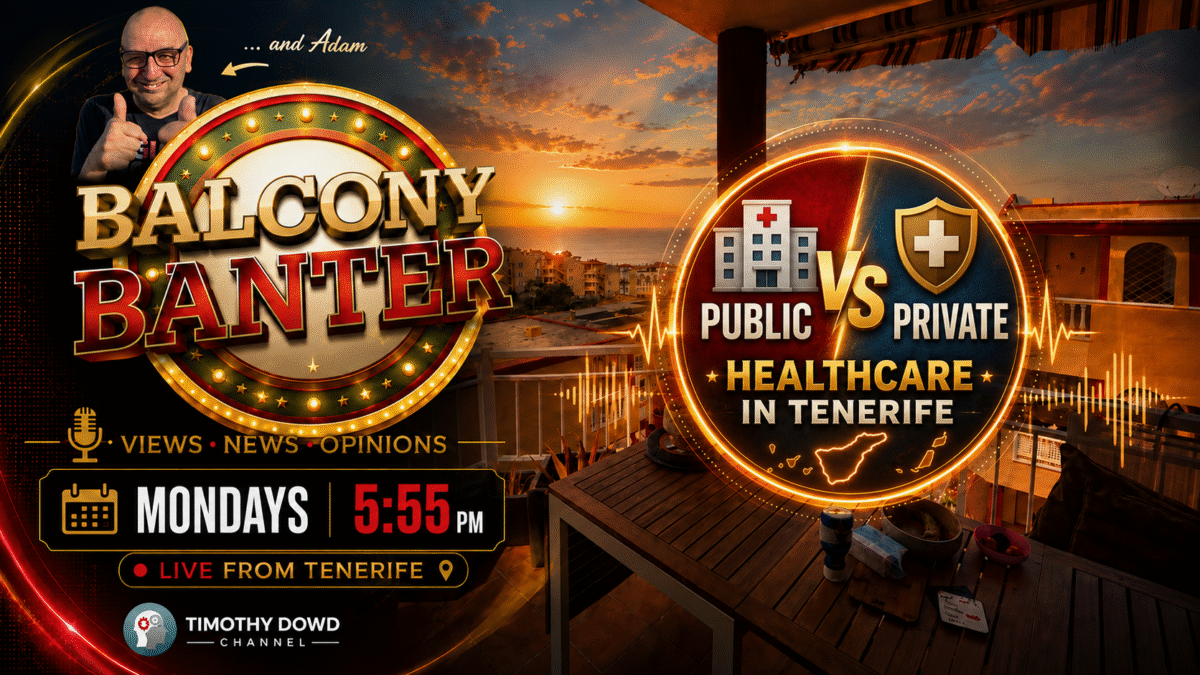
Balcony Banter returned with Christine, Clio and Adam joining me on the balcony in Tenerife. We eventually reached the planned subject of public healthcare and private health insurance, although not before a lengthy discussion about full English, Scottish and Irish breakfasts.
The breakfast conversation followed my morning visit to the Olive Garden in the Pasarela Centre with Gordon. I chose the mega extreme English breakfast, while Gordon had the Scottish version. That led to a useful comparison involving black pudding, white pudding, tattie scones, square sausage, soda farls and potato bread.
A Different Experience of Public Healthcare
Clio introduced the main topic by explaining her experience of growing up in Ireland. Visiting a doctor was generally something her family paid for directly, and it was normally reserved for occasions when treatment was genuinely necessary.
After moving to Tenerife, she found the Spanish public healthcare system very different. She described it as a revelation, particularly after having her daughter here and later needing treatment herself.
Her experience has included regular GP care, tests, hospital treatment and preparations for spinal surgery. She also explained that public and private healthcare can work together. A private specialist can request tests, while the public GP may arrange them and accept the results as part of the same course of treatment.
Public and Private Hospitals Working Together
The south of Tenerife does not yet have the same range of public hospital facilities as the north of the island. When suitable treatment can be carried out in a private hospital in the south, the public health service may pay the private hospital to provide it.
For patients, the important point is that the treatment remains part of the public system. They are not necessarily forced to travel across the island or pay privately simply because the nearest suitable facility is privately operated.
Clio also spoke positively about the health service app, which allows her to see appointments, medication and test information. She said that GP appointments are normally available within about a week, while nursing appointments can often be arranged more quickly.
Home visits can also be organised when a patient cannot reasonably get to the clinic. Christine now receives care at home when necessary, and Clio was told that a nurse could visit after her spinal operation if the wound needed daily attention.
Children’s Healthcare in Tenerife
One of Clio’s strongest points concerned the attention given to children during their early years. Her daughter received regular checks covering general health, development, posture, eyesight, speech and other important areas.
Because Clio has scoliosis, her daughter’s posture was monitored particularly carefully. The appointments were not treated as optional extras. They were seen as part of giving a child the best possible start in life.
Experiences from Ireland and the UK
Viewers shared mixed experiences of healthcare in Ireland and the United Kingdom. Some had received excellent NHS treatment, while others mentioned delayed appointments, long waiting lists and pressure on hospitals.
Clio said that she had never felt Ireland had a genuinely universal public system during her childhood. Private insurance later became important to her, especially when waiting for treatment would have meant living with severe pain for many months.
The discussion also touched on Scotland, where healthcare is administered separately, and Germany, where Christine was able to compare her earlier experiences with the care she now receives in Tenerife.
Is Private Health Insurance Worth the Cost?
Private insurance can be valuable when it provides rapid access to scans, specialists or operations. However, it can become expensive with age, and previous medical conditions may be excluded or make cover difficult to obtain.
We discussed an occasion when Christine faced a long wait for a non-urgent scan. Rather than paying insurance premiums for years, we paid approximately €350 to have the scan carried out privately the following day. The results could then be taken back into the public system.
That raised a practical question: does private insurance always represent good value, or can it sometimes make more sense to use the public system and pay directly for the occasional private test?
There is no single answer. It depends on age, health, waiting times, exclusions, income and the amount of reassurance a person gets from having private cover.
Should Healthcare Be Run for Profit?
The final part of the discussion moved beyond individual insurance policies. We asked whether healthcare should be free at the point of use and funded collectively through taxation.
Essential services still cost money. Doctors, nurses, researchers, cleaners, technicians and administrators all need to be paid. The real argument is about who provides the service, how it is funded and whether private profit should determine which treatments are developed or made available.
My view is that healthcare should be treated as a basic public responsibility. A country should look after its people in the same way that a family looks after its members. That includes caring for people who are ill, helping those who have fallen out of work and making sure nobody disappears through the cracks.